I build the software. Then I hand you the keys.
I find the work quietly eating your week — the manual grind, the systems that don't talk, the tool nobody's left to fix — and turn it into software you own and can count on. And I do it in person, here in Chicago, so you always know exactly who built the thing your business runs on.
The proof · in production
A working tax practice runs on software I built.
Not a mockup. Not a pilot. It went live in early 2026, and their people have been working in it every day since.
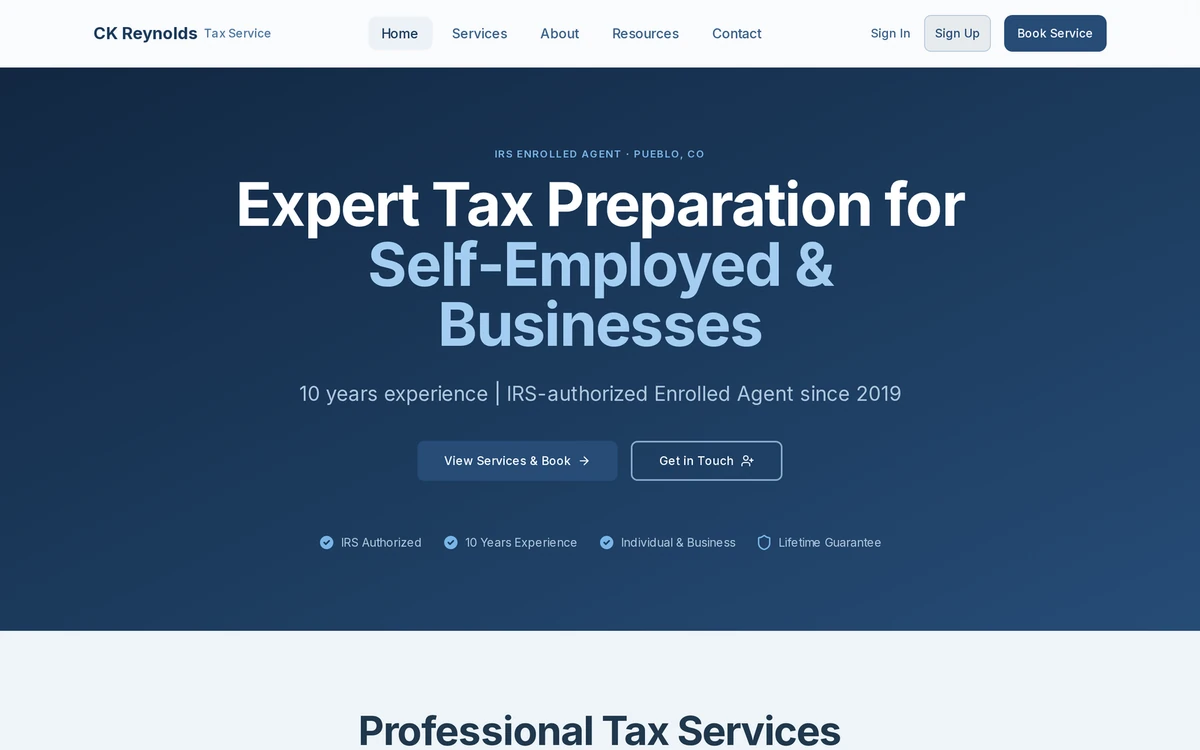
REPLACED
What it replaced
Manual steps, spreadsheets, and a handful of tools that didn't talk to each other. The same client details typed in again every time the work moved somewhere new.
BUILT
What it does
Client intake. Document management. The whole workflow that carries each client from signup to filed return — everything the practice runs on except preparing the return itself. Reporting on top of it all, in one place.
SHIPPED IN
Working in days. Whole platform in a month.
They had something working in days — the real thing, with their own data in it, not a demo. The full platform was done inside a month of focused work — one person's month, which is the whole reason it didn't cost an agency's price.
Your firm probably doesn't need a tax platform. But you have something that lives in spreadsheets and in one person's head. Same job. See how this one was built →
Run a tax or bookkeeping practice? I can set this same platform up for yours.
See what you'd get →What I get called about
Nobody calls a developer about software. They call about these.
None of these are technology problems. They're hours, clients, and money leaking out of a process that grew one workaround at a time. Here's what I build to stop each one.
You're drowning in manual data entry
You're drowning in manual data entry
The same client typed into three systems. Invoices rekeyed out of email. The Friday report rebuilt by hand, again. I build software that does the typing for you, on the computers you already have. You get the hours back, and the typos stop costing you.
01
Onboarding a client takes three days when it should take three minutes
Onboarding a client takes three days when it should take three minutes
Engagement letter, intake form, document requests, and the emails chasing the one missing signature. I build a single intake flow: the client fills it out once, the documents land where they belong, and the file opens itself. The three-day scramble is over, and nobody walks because the paperwork took a week.
02
You can't see your real numbers without merging four spreadsheets
You can't see your real numbers without merging four spreadsheets
Billables in one file, receivables in another, capacity in somebody's head. By the time you've merged them, the numbers are a week old. I build one screen that pulls from the systems you already use and keeps itself current. You look once and you know where the month actually stands.
03
You're paying for five tools that don't talk to each other
You're paying for five tools that don't talk to each other
The same client's name keyed into billing, the document folder, the calendar, and whatever tracks the work. I connect what you already pay for so one update shows up everywhere, and I replace the ones you're paying for and barely using. Fewer subscriptions. One version of the truth.
04
Calls come in when nobody's there to answer them
Calls come in when nobody's there to answer them
Every call that rings out is a client calling somebody else. I build the system that picks up when you can't: it takes the caller's name, number, and what they need, answers the handful of logistics questions people always ask — hours, location, what to bring — and drops a finished, written request in your queue. It doesn't give advice and it doesn't pretend to be a person. This one isn't hypothetical — it already runs on my own line as an assistant named Iris, booking a time whenever I can't pick up. The 4:40 call on Friday is still a client on Monday.
05
The last developer vanished and nobody can touch the system
The last developer vanished and nobody can touch the system
The tool your office runs on, built by somebody who stopped answering. No documentation, no password, nobody left who understands it. I take those jobs. I get in, write down how it actually works, fix what's broken, and hand you the keys. You own the code, so it can't happen to you a second time.
06What it costs
Most projects run $1,000–$20,000. Small ones ship in days.
The whole list is right here — no "call for pricing." Fixed price in writing before I start, no hourly meter, no surprise invoice. Two sizes: one process replaced, or the whole operation in one place. Estimate your project →
01 · The Fix
$1,000–$5,000
One process that eats hours, replaced — usually in days.
02 · The Platform
$5,000–$20,000
The whole operation in one place — about a month of focused work.
Fixed price, in writing.
Before I start. Hardware or cloud, if any, passed through at cost — never marked up.No monthly fee.
If it breaks and it's my fault, I fix it free. After that, help is hourly — only when you want it.You own it.
The code, the accounts, the keys, handed over. Lock me out in about a minute.Why weeks, not months — and why this number?
I'm one person, not an agency: no sales team, no account managers, no overhead priced into your quote. I reuse the parts I've built before and read and test what ships, so a full platform is about a month of my focus, not six. What you're not paying for is four people re-inventing it on your invoice.
Taking on three to five more first clients at a reduced rate, in exchange for a case study and a testimonial when the work's done. Call me and mention it — I'll tell you if a slot's still open.
How it works
Three steps. No discovery phase, no jargon.
You tell me what's broken.
Twenty minutes on the phone, free. Where the hours go. What gets retyped. Which client slipped through the cracks last month. No prep, no deck.
You get a fixed price. In writing.
Most projects land between $1,000 and $20,000. No hourly meter, no change orders. If it isn't worth building, I'll say so — and you're out twenty minutes.
I build it. You own it.
Days, not months. When it's done, all of it is yours — the software, the accounts, the passwords. Thirty days of support after that.
Before you hand anyone your client data
I break into my own software before I give it to you.
Your client files are the firm. Returns, case files, everything people trusted you with. Most of the people quoting you on this work have never thought about that for one minute. It's the first thing I think about.
I ATTACK ITYour software gets hunted before it ships
Your software gets hunted before it ships
I built a red team out of AI agents whose only job is breaking in, and I aimed it at my own platform first — every service I run. It found real ways in. I closed them. Everything I build for you goes through that same gauntlet before it's ever in your hands.
I BUILD IT SHUTLocked down from the first line, not the last
Locked down from the first line, not the last
Security isn't a step at the end that gets cut when the budget gets tight. It's how the thing gets built: who can see what, what gets logged, what happens when someone tries a door they shouldn't. Bolting it on afterward is how firms get hurt.
YOU HOLD THE KEYSMy access ends when the project does
My access ends when the project does
You hold the accounts and the passwords. You can lock me out in about a minute, and I'll show you how on the day I hand it over. I'll sign your NDA — before the first call, if you'd rather sign before you tell me anything.
Who you're calling
D. Michael Piscitelli
Engineer · Uptown, Chicago
In 2016 I had a telecom design job, a new condo, and a commute I couldn't stand. I waited out the lease, put a folding desk and a laptop in an ’05 Subaru WRX, got an okay from my company, and left. I worked out of Virginia, Colorado, Nevada, California and Tennessee — about six thousand miles — and somewhere in the middle of it I met the love of my life. Burlington, then Denver, then Chicago.
The rest of the story
A few years ago I told my VP I was bored. He put me on a struggling fiber project as team lead: five people, paid by the foot, a hundred thousand more homes and businesses to reach. Then he gave me one wildcard shot at a deliverable the customer needed. I built it in under a week, and the project ran on it for years.
Nobody asked for the second one. I built it anyway, and then seven more. I already had the engineering — aerospace at Syracuse, ten years of network design — and AI closed the gap in my coding. That year my crew out-earned the managers.
Within months of the fifth tool, they cut our rate per foot. I had made the work faster, and the company kept the difference.
That is the whole reason I do this now. When I save a small firm ten hours a week, nobody upstairs takes it back. The owner keeps it. The value stays where it was made.
So I spent two thousand hours in a terminal learning to build with agents — beta-testing other people's, then building my own — and started this practice. One person. Not a firm, not a front for one. A practice held together by twelve spreadsheets and one person's memory is not going to scare me.
Before this
I've been the person who automates the work nobody wants to do by hand
Before this — tooling inside a large operation
Years inside a large engineering operation, building the internal tools a production team depended on every day — the ones that planned the work, produced the deliverables, and caught the mistakes before a client ever saw them. This is the enterprise side of “I do more” — separate from the apps and experiments in my lab.
The deliverable that didn't exist
A complex recurring deliverable was still being assembled by hand, and nobody had automated it. I got one wildcard shot and made it in a week: three raw exports in, a flawless color-coded, labeled document out. It shipped on every job for years, and it never came back with a correction.
01A parts list that checks its own work
The team was paid by output, so every hour hand-building a parts list was money on the floor. I made it instant — two exports in, a complete list out — and had it catch its own naming and data-gap errors before anyone saw them. The reworks stopped. A one-click sidebar killed the manual typing of hundreds of names.
02Making the invisible visible
Thousands of broken links were scattered through the project data — invisible in the tool everyone used, each one a landmine that stalled someone mid-job. I built the check that showed every one in red. It became the standard everyone ran before every job.
03Nothing left behind
Records kept going missing across a very large dataset, and people billed hours hunting them — and still missed some. I built a browser tool that reads a screenshot pixel by pixel, finds every gap, and pins them on a real map. It guaranteed what people couldn't.
04The numbers the team planned against
Before the team could start on an area, someone had to decide where its boundaries went and how much capacity it needed. I built the calculator that decided it: paste an area's data into Sheets and get the requirement back, with growth and density factored in. What I handed the team was computed, not guessed.
05A clustering algorithm to place the hard points
Where the key hard points belong isn't obvious — it's a geospatial optimization against a spec. I wrote an algorithm that groups location data into variable clusters and estimates the points that best satisfy each boundary. It's how I tuned a plan before the team drew a single line.
06The spreadsheet that couldn't be wrong
A new build needed math that, if it's off, fails at the farthest edges of the system. The old spreadsheet was inaccurate and didn't work. I built a spec-true calculator in two days — self-contained, offline, drop it in a browser. No server, no rollout.
07One place the team ran on
My tools and updates were scattered across chat, email, and spreadsheets. I built a single hub the team worked out of every day — so the tooling was something they used, not something they hunted for.
08One tool instead of everyone's private hack
Everyone had their own notepad-and-Excel method, pulling from five documents and correcting by hand all day. I replaced it with one clean app — data in, two finished deliverables out — used four to eight times a day, per person. I adapted it for a second team, too.
09That work is where the craft came from. I build for small businesses now — where the person who owns the place is the same person who benefits when the work gets faster.
Straight answers
Questions worth asking before you hire anyone
What does it cost?
Most projects run $1,000 to $20,000. A quick fix starts around $1,000. A full platform tops out around $20,000. For comparison: of the Chicago agencies listed publicly, almost nine in ten won't start a project under $5,000, and nearly half won't start under $25,000. You get a fixed price in writing before I begin. No hourly meter, no surprise invoices. If your problem isn't worth paying to fix, I'll tell you that for free.
How fast can you build it?
Days, not months. A small tool ships in days; a full platform is about a month of focused work — the tax platform on this page took that. I reuse the parts I've built before and let modern tooling handle the repetitive writing, then I read and test what goes out the door. You'll hear the real timeline up front, not in month three.
Who owns the code when it's done?
You do. Outright. The code, the accounts, and the passwords get handed over, and they're yours. No license. No monthly fee to keep your own software running. Nothing you have to keep paying me for. If you want to hand it to another developer a year from now, you can. Nobody has to ask my permission.
What if you get hit by a bus?
Fair question. You're hiring one person and you should ask it. The answer is that you already hold everything — nothing about your business runs through a door only I have the key to. Another developer can pick it up and keep going. You're buying software, not a dependency on me.
Do you stick around after launch?
Yes, and never on a retainer you're forced into. Your software keeps working whether or not you keep paying me, because you own it — and there's no monthly fee. When something breaks or you want it to do something new, call me: you get a diagnostic call fast, usually same day, and most things are fixed the same day. You only pay when you want me. The tax platform on this page has been in daily use since early 2026. What I build is meant to keep running.
Are you actually in Chicago?
Yes. I work out of Uptown, and Chicago firms are who I build for. If you'd rather meet in person, I'll come to your office.
Will you see our client files?
Where the work requires it, yes — you can't fix an intake process without seeing what moves through it. So: I'll sign your NDA, and I'll sign it before the first call if you want it signed before you tell me anything. I work on the least amount of live client data the job allows, and I use scrubbed or sample records wherever a real file isn't necessary. The software itself gets attacked before you ever run it: I built a red team out of AI agents that hunts for a way in, and I fix what it finds first. When the project ends, my access ends — you hold the accounts and the passwords, and you can lock me out in about a minute. If your firm has rules about where data is allowed to live, tell me on the first call and I'll build inside them.
Get started
Tell me what's slowing your firm down.
I'll tell you what it'd cost to fix. Usually under $20,000. The first 20 minutes are free, and you leave with a number whether you hire me or not.
Calling is the easiest way in. The number goes straight to my phone and I answer myself. If I can't pick up, my assistant Iris books you a time — you never hit a dead end. Prefer to write it out? Use the form.